
On December 10, 2025, the National Assembly passed the Law amending and supplementing a number of articles of the Law on Intellectual Property, which will take effect from April 1, 2026.
From a policy perspective, this is not just a technical adjustment but the next step in the restructuring process of the intellectual property law system along three main axes:
- Streamline procedures, expedite the establishment of rights.
- Strengthening enforcement, especially in the digital environment.
- Repositioning intellectual property rights as a genuine economic asset.
These changes clearly reflect the direction: to make intellectual property a genuine, functioning component of the economy, rather than merely a formal protection mechanism.
I. Procedure reform: from “record management” to “rights administration”
The most noticeable benefit is the significant reduction in application processing times.
- Patent examination period: 12 months (instead of 18 months)
- Industrial design and trademark: 5 months
- The time limit for requesting patent examination has been reduced from 42 to 36 months.
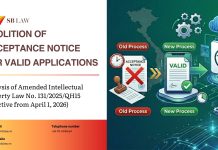
At the same time, trademark procedures were simplified by publishing them immediately after valid acceptance and eliminating the intermediate step of notifying acceptance/rejection of formal examination.
In terms of policy, this is a shift in thinking:
The intellectual property system no longer focuses on “file control,” but on “facilitating early establishment of rights.”
In the context of innovative businesses operating with short product lifecycles, early patent registration is crucial for their ability to raise capital, secure contracts, and compete in the market.
However, the question arises: is the assessment capacity sufficient to meet the shortened timeframe while still ensuring the quality of administrative decisions? Without accompanying personnel reforms and process digitalization, shortening the timeframe may remain just a goal on paper.
II. Enforcing Rights: Strengthening Accountability in the Digital Environment
The 2025 amendments to the law clearly demonstrate a stance against the current state of rights violations in cyberspace.
For the first time, “owners/operators of digital platforms” are recognized as entities with legal responsibility in protecting intellectual property rights.
This is a crucial shift:
From a passive “notify-remove” model to a more proactive and responsible platform model.
In parallel, the law adds civil and temporary emergency measures specifically applicable to the digital environment: removing, hiding, and disabling access to content, accounts, websites, and applications.
From an enforcement perspective, this is a necessary tool. However, the line between protecting rights and the risk of over-enforcement is also an issue that needs careful guidance to avoid impacting freedom of business and access to information.
Raising the compensation amount to 1 billion VND and changing the method of calculating emotional distress based on the plaintiff’s income also reflects a trend towards increased deterrence and closer alignment with practical dispute resolution.
III. Adapting to Artificial Intelligence: A First, but Cautious, Step
For the first time, the law officially addresses artificial intelligence (AI).
Two directions have been established:
- AI is not recognized as the author of inventions or industrial designs – intellectual property rights remain tied to humans.
- Allow the use of legally published data to train AI, provided it does not unreasonably prejudice rights holders.
This regulation raises several policy questions:
- What constitutes “unreasonable harm”?
- Does this apply to input data or output products?
- Who bears the burden of proof?
It appears that lawmakers have chosen a cautious approach: opening the door to research and innovation, but not yet delving into the legal framework for AI-powered products.
Therefore, the guiding decree will play a decisive role in shaping AI policy in Vietnam.
IV. Adjusting the protection structure: moving closer to international practices.
The amended law has been expanded:
- Partial design protection
- Protection of intangible design (user interface, graphic images)
- Apply anti-duplication principles to both trademarks and designs.
These changes reflect a trend toward aligning with international practices and meeting the demands of the digital economy, where value lies not only in tangible products but also in design and experience.
Notably, the tightening of protection for the national name “Vietnam” reflects a clear policy stance: the national name is a public asset and cannot easily become a private monopoly.
V. Copyright: Clarifying boundaries and reducing conflicts
The supplementary law clearly excludes: ideas, slogans, and titles of works (considered independently) are not eligible for protection.
This is a necessary step to curb the practice of overly defensive registration of elements that lack sufficient originality.
Expanding the concept of “recording producer” to include the initiating and responsible entity also reflects an approach based on investment and risk control, rather than solely on purely technical behavior.
VI. Repositioning Intellectual Property Rights as an Economic Asset
Perhaps the most fundamental change is the addition of a provision recognizing intellectual property rights as a class of assets that can:
- Valuation
- Mortgage
- Capital contribution
- Used as collateral
At the policy level, this is an important statement:
Intellectual property is not just for protection, but also for exploitation.
However, its practical effectiveness will depend on the system of guidelines for valuation, accounting, and registration of secured transactions for intangible assets. Without a synchronized technical mechanism, this regulation may remain merely a general principle.
Conclusion: Reforms are in-depth, but the challenge lies in implementation.
The revised Intellectual Property Law of 2025 reveals three major trends:
- Faster procedures
- Stricter enforcement
- Policies for adapting to the digital economy and AI.
However, like all legal reforms, success lies not in the wording but in the implementation.
The period from now until the law takes effect is a crucial time for businesses:
- Review of the intellectual property asset portfolio
- Consider the registration and exploitation strategy.
- Assessing the risks associated with AI and the digital environment.
- Prepare for the possibility of using intellectual property rights as collateral.
If implemented consistently, the 2025 amendments to the law could become a turning point, bringing Vietnam’s intellectual property system closer to a model of “intellectual property governance” instead of just “application management”.
If you have any questions or need clarification, please feel free to contact us. The intellectual property legal team at SB LAW is always ready to assist you.
Contact information:
Website: https://sblaw.vn/
Hotline: (+84) 904 340 664
Email: ha.nguyen@sblaw.vn
By Dao Thu Trang
Head of Patent Department