




Decree No. 56/2009/ND-CP on sanctioning administrative violations in cultural and information activities
Decree No. 56/2009/ND-CP was passed on June 6, 2006. This Decree governs issues on acts, competence and procedures for sanctioning administrative violations in the culture and information activities.
Administrative violations in cultural and information domains defined in this Decree include acts of violating state management regulations in press activities; publishing...

Circular No. 22/2009/TT-BTC Guiding the Collection, Payment, Management and Use of Industrial Property Fees and Charges
Circular No. 22/2009/TT-BTC was enacted on February 04, 2009. The Circular includes 3 major parts and one Annex setting out the table of industrial property fees and charges rate. This Circular defines issues on procedures for collecting, paying (the way to pay, type of money, time…) and managing and...

Competition Law, 2004:
The Competition Law was passed on December 3, 2004 and came into force on July 1, 2005.
It foresees general provisions for acts of competition’s restriction and of unfair competition. The law also provides procedures for the settlement of competition cases and measures to deal with violations of the competition...

Law on Science and Technology
Law on Science and Technology was promulgated under No. 21/2000/QH10 of June 9, 2000. The scope of regulation is regulating issues on scientific and technology organizations, individuals involved in scientific and technological activities and organization of scientific and technological activities. This Law was divided into 2 sections and 59...
Decree No. 106/2006/ND-CP of September 22, 2006, providing for sanction of Administrative Violations in the field of intellectual property
Decree No. 106/2006/ND-CP was adopted on September 22, 2006. This Decree provides for administrative violations in the domain of intellectual property, sanctioning forms and levels, sanctioning competent and procedures as well as remedies. The Decree is composed of 5 chapters and 37 articles and entered into force on October...
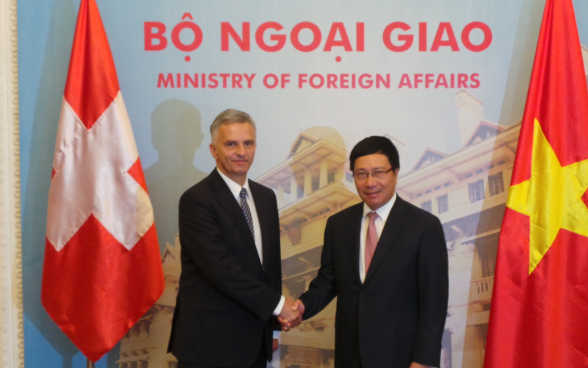
Agreement between the Government of the Socialist Republic of Vietnam and the Swiss Federal Council on the Protection of Intellectual Property and on Co-operation in the Field of Intellectual Property
Agreement between the Government of the Socialist Republic of Vietnam and the Swiss Federal Council on the Protection of Intellectual Property and on Co-operation in the Field of Intellectual Property was adopted on 6 and 7 July 1993. The Agreement comprises 9 articles and 2 Annex providing for an...

Instruction Number 04/2007/CT-TTg of 22 February 2007 on the strengthening of computer program copyright protection
Instruction was promulgated by the Prime Minister on February 22, 2007. The goal of this Instruction is to take directions for the strengthening and maintaining of computer program copyright protection. To get a high result, Prime Minister requires Ministries such as Ministry of Public Security, Ministry of Defense, Ministry...

Intellectual Property Law, 2009:
The Intellectual Property Law was passed by the Vietnamese National Assembly on June 19, 2009 and came into force on January 1, 2010. This law aimed to amend and supplement some articles of the former Intellectual Property Law passed in 2005.
One of the new law major provisions’ is, firstly,...

Budapest Treaty on the International Recognition of the Deposit of Microorganisms for the Purposes of Patent Procedure
Budapest Treaty on the International Recognition of the Deposit of Microorganisms for the Purposes of Patent Procedure was passed on Budapest on April 28, 1977, and amended on September 26, 1980. Budapest Treaty includes 4 parts and 20 articles relating to patent procedure. The main feature of the Treaty is...

Trademark registration: New process – according to Amended Law No.131/2025/QH15
The Law amending and supplementing several articles of the Intellectual Property Law No. 131/2025/QH15 will officially take effect on April 1, 2026. One of the most breakthrough changes and powerful administrative reforms regarding industrial property registration applications (including trademark applications) is the abolition of the procedure for issuing a...

Decree No. 24/2025/ND-CP: Amending and supplementing regulations on penalties for administrative violations in commerce and consumer protection
Decree No. 24/2025/ND-CP, issued on February 21, 2025, amends and supplements several articles of Decree No. 98/2020/ND-CP on penalties for administrative violations in commercial activities, production, trading in counterfeit and prohibited goods, and consumer protection. This Decree aims to update and adjust regulations on administrative penalties in these fields...

New techonology transfer law (effective from April 1, 2026): Promoting the dissemination of medical and educational technology and breakthrough investment incentives
From April 1, 2026, the new Law on Technology Transfer will officially take effect, bringing strategic changes to promote endogenous capacity and modernize the country's key sectors. This is considered an important turning point helping businesses access new incentive policies while improving the quality of people's lives through technology.
...