
Issuing Joint Circular guidance for handling trade name infringement of industrial property rights in Vietnam.

In 05 April 2016, the Ministry of Science and Technology and the Ministry of Planning and Investment issued the Joint Circular No. 05/2016 / TTLT BKHCN-MPI detailed regulations and guidelines for case handling trade name infringement of industrial property rights. This Joint Circular apparently shall become effective on May 20, 2016. SBLAW would like to provide you with the following summary of the Circular:
The Joint Circular provides detailed guidelines on how IP (trademark, trade name, geographical indication) owners can deal with a trade name which infringes upon their IP rights.
The Joint Circular provides procedures for the IP right owners to enforce a decision issued by the competent authority if:
- A conclusion has been issued that the use of trade name infringes upon the IP rights of others (without any administrative sanctions), there is a reasonable time (30 days) for two parties to negotiate a dispute resolution (which may include a timeframe). If a resolution is not agreed, the IP right holder may ask the DPI to force the name change; or
- If a decision which provided an administrative sanction of forcing the change of company name has been issued by the competent authority, the infringer has 60 days to proactively change their trade name, otherwise the authority who issued the administrative sanction decision will request the DPI to implement the decision. Accordingly, DPI will be forced to change the name or even withdraw.
Madrid agreement and protocol concerning the international registration of marks
|
MM18(E)
MADRID AGREEMENT AND PROTOCOL CONCERNING THE INTERNATIONAL REGISTRATION OF MARKS declaration of intention to use the mark – United States of America (to be annexed to each international application or subsequent designation in which the United States of America is a designated Contracting Party) IMPORTANT
World Intellectual Property Organization 34, chemin des Colombettes 1211 Geneva 20, Switzerland Tel. (Switchboard): +41 (0)22 338 9111 Fax (Madrid Registry): +41 (0)22 740 1429 e-mail: intreg.mail@wipo.int – Internet: http://www.wipo.int |
|
MM18(E) |
||
|
Declaration of intention to use the mark: United States of America By designating the United States in the international application/subsequent designation, the person signing below declares that: (1) the applicant/holder has a bona fide intention to use the mark in commerce that the United States Congress can regulate on or in connection with the goods/services identified in the international application/subsequent designation; (2) he/she is properly authorized to execute this declaration on behalf of the applicant/holder; (3) he/she believes applicant/holder to be entitled to use the mark in commerce that the United States Congress can regulate on or in connection with the goods/services identified in the international application/subsequent designation; and (4) to the best of his/her knowledge and belief no other person, firm, corporation, association, or other legal entity has the right to use the mark in commerce, either in the identical form thereof or in such near resemblance thereto as to be likely, when used on or in connection with the goods/services of such other person, to cause confusion, or to cause mistake, or to deceive. I declare under penalty of perjury under the laws of the United States of America that all the foregoing statements are true and correct to the best of my knowledge and belief. I understand that willful false statements and the like may jeopardize the validity of the application or document or any registration resulting therefrom, and are punishable by fine or imprisonment, or both (18 U.S.C. §1001). 35 U.S.C. §25(b). ________________________ ___ August, 2015 Signature Date of execution (dd/mm/yyyy) Signatory’s Name (Printed) INSTRUCTION This declaration must be signed by: (1) the applicant/holder or a person with legal authority to bind the applicant/holder; or (2) a person with firsthand knowledge of the facts and actual or implied authority to act on behalf of the applicant/holder; or (3) an attorney who is authorized to practice before the United States Patent and Trademark Office under 37 C.F.R. §10.1(c), who has an actual written or verbal power of attorney or an implied power of attorney from the applicant/holder. |
||
| INFORMATION REQUIRED BY THE INTERNATIONal BUREAU
(a) Where the present declaration refers to an international application based on a basic application, indicate: Basic application number: Date of the basic application: (dd/mm/yyyy), or (b) Where the present declaration refers to an international application based on a basic registration, indicate: Basic registration number: Date of the basic registration: (dd/mm/yyyy), or (c) Where the present declaration refers to a subsequent designation of an international registration, indicate: International registration number: International Bureau’s reference (where applicable): Name of applicant/holder: |
||
Register a new trademark in Vietnam
Question: We want to proceed to register a new trademark in Vietnam.
We want to know how much is the cost to file an application of trademark in Vietnam (Official fees, attorney fees …all cost included)
Please could you send us the required information, so we can inform our client, and after we will confirm you if the application will be done.
Thank you so much for your attention.
Answer: Thank you very much for your email regarding the subject matter. Regarding your enquiries concerning the subject matter, we would like to advise you on the procedure and our fee schedule in relation to the trademark registration proceeding in Vietnam as follows:
1. FEE SCHEDULE
In Vietnam, multi-class application is applicable. The basic fees are calculated based on the number of class of goods/services (G/S) in each application as well as the number of products designated in each class in the application.
Below is the breakdown of charges for search and registration for one trademark in a smooth case, for your consideration:
1.1 Fee for searching of 01 trademark/01 class
|
Description |
Official Fees (USD) |
Attorney’s Fees (USD) |
| Fee for conducting 01 trademark search in 01 class (optional) |
– |
100.00 |
1.2. Fee for registration of 01 trademark
|
Description |
Official Fees (USD) |
Attorney’s Fees (USD) |
| 1. Fee for filing to registration for the first class of G/S with up to 6 products/services in one class (including fee for granting certificate) |
80.00 |
200.00 |
| 2. Fee for filing to registration for the second class of G/S with up to 6 products/services in one class (including fee for granting certificate) |
50.00 |
130.00 |
| 3. Fee for each additional goods from 7th one (if any) |
7.00 |
3.00 |
Note: The above-quoted fees do not include 5% VAT of our service charge, bank charges ($US30) and actual communication costs ($US30-$US40), additional fees in case of refusal (due to similarity to /identity with other trademarks which were already registered). In case of any office action or any possible opposition which may occur during the application proceedings, an additional charge may be incurred, upon your approval.
2. PROCEDURE AND TIMELINE
The duration of a trademark search is around 05-10 working days. The duration of trademark application is around 14-18 months – from the filing date to the actual receipt of the registration.
The process involves these stages (1) formal examination and publication in the Gazette (3 months); (2) examination as to substance (9 months) and (3) issuance of registration certificate of the registered mark (2 months).
Kindly note that the term for registration process in practice normally takes up to several months longer due to the workload of the NOIP and the slow examination process by the NOIP’s examiner.
3. REQUIRED DOCUMENTS AND INFORMATION
– Name and address of the Applicant;
– List of Goods/Services;
– Specimen of the applied mark;
– An original Power of Attorney which is simply signed by the Applicant (Please be informed that a scanned/faxed copy of the Power of Attorney is acceptable upon filing provided that the original copy is submitted within 01 month from the filing date).
We hope the above is of your assistance. Should you have any inquiry, please do not hesitate to contact us. We look forward to hearing from you very soon.
Intellectual Property Rights Services in Vietnam

We “SBLAW” have been widely appreciated as a leading IP law firm in Vietnam Backed by our capabilities, we have been able to offer cutting-edge solution to corporations, individuals and international entities across the globe.
Our workforce comprises eminent lawyers and advocates having expertise in handling matters before the District Courts, High Court, Tribunals, Commissions and the Supreme Court and arbitration of Vietnam .
We have expertise in handling matters pertaining to intellectual property rights which includes the following:
– Filing of trademark, patent, copyright and design applications
– Filing of PCT Applications designating Vietnam
– Handling and Prosecuting of Oppositions in Trademark and Patent matters
– Handling of Cancellation and Rectifications petitions pertaining to Trademarks, Patents, Designs and Copyright
– Handling and attending of cases before the Tribunal specially designed to hear Intellectual Property matters and before all courts including District Courts, High Courts and Supreme Court and International Arbitration of Vietnam
– Drafting, negotiating and concluding, license, franchise and distribution agreements pertaining to intellectual property rights
– Handling of domain name disputes
With years of experience in Intellectual Property Law including trademark, Patent, Copyright, Design filing, prosecution and enforcement in Vietnam, we are certain we can provide with excellent services, top expertise, and more than just a competitive pricing.
We have been providing IPR services to high tech start-up companies, pharmaceutical corporations, Multinational Houses, Law Firms, Fashion Designers, manufacturers, Technology and IT corporates etc..
For further information on the services rendered by our firm please visit our website www.ipright.vn
We will be happy to assist in filing new applications pertaining to IP or handling the existing ones, as well as any other intellectual property matters the client may have in Vietnam.
Lawyer SBLAW has joined the IPR roundtable at American Center, Diamond Plaza, HCMC.
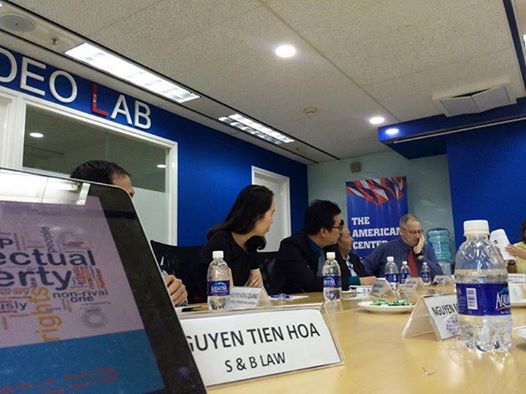
Lawyer Nguyen Tien Hoa, parter of SBLaw has joined the IPR roundtable at American Center, Diamond Plaza, HCMC.
As part of the series of activities to celebrate the 20th anniversary of U.S.-Vietnam diplomatic relations, Associate Justice of the U.S. Supreme Court Ruth Bader Ginsburg has visited Vietnam and accompanied by her daughter, Dr. Jane Ginsburg, a professor at the Columbia University School of Law
IPR roundtable was hosted by the US Consulate General and attended by over 10 IP lawyers and members of the HCMC Intellectual Property Association and Intellectual Asset Management Club. This roundtable provided a forum to talk about recent IPR success stories, challenges, and opportunities for joint collaboration to address IPR enforcement. The United State Patent and Trademark Office’s Regional Attaché for Southeast Asia, Peter Fowler, facilitated the roundtable.
After the roundtable, an IP network between participants has been created.
Photo of IPR roundtable

Vietnam trademark registration

Question: Hello SB Law,
My company is contracting some factories in Binh Duong Province to make products (travel accessories, luggage, ect), and my company wants to file a trademark registration in Vietnam.
Can you tell me more about the trademark registration process, and how long does it take, and much would it cost?
Again thank you for your time.
Answer: Thanks for your following letter. As the leading IP firm in Vietnam, it is our pleasure to provide us the service with affordable fee and qualified service.
In order to help us to provide our fixed quotation, could you provide us the full list of your products or services bearing under your trademark?
We look forward to hearing from you soon.
Vietnam jurisdiction of settling the infringement action.

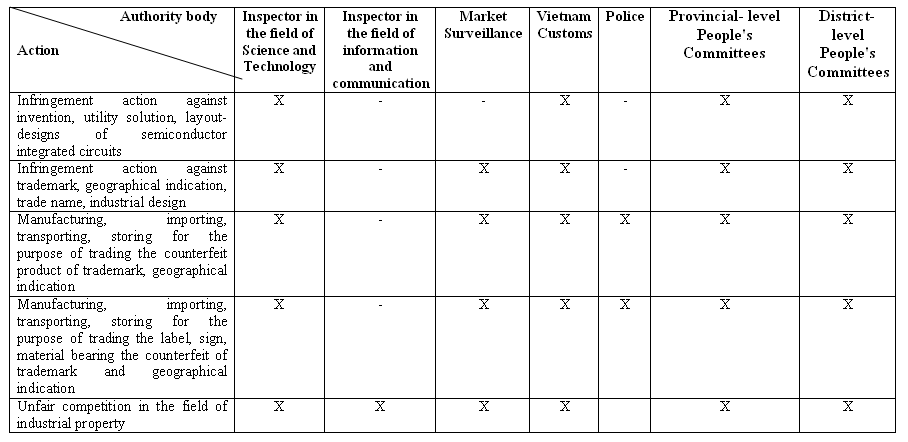
According to the Decree No. 99/2013/NĐ-CP of Government dated August 29, 2013 providing for Sanctioning of Administrative Violations in Industrial Property, the following authority state bodies have the jurisdiction in settling the IP infringement action in Vietnam:
– Inspector in the field of science and technology;
– Inspector in the field of information and communication;
– Market Surveillance;
– Vietnam Customs;
– Police;
– Provincial- and District-level People’s Committees;
1. The difference of the jurisdiction in settling the IP Infringement Action of the said authority bodies:
Depending on the infringement action, the aforementioned authorization agencies have the difference jurisdiction in handling and settling the infringement as following table:
Table 1
2. The inspector in the field of science and technology
The inspector in the field of science and technology including the following person and authority state bodies:
– Inspector of Ministry of Science and Technology (MOST);
– Head of Inspector of MOST;
– Inspector of Department of Science and Technology of Province (DOST);
– Head of Inspector of DOST;
– Head of the inspectation of DOST (case by case);
– Head of the inspectation of MOST (case by case);
The jurisdiction of the inspector in the field of Science and technology are as following table:
Table 2

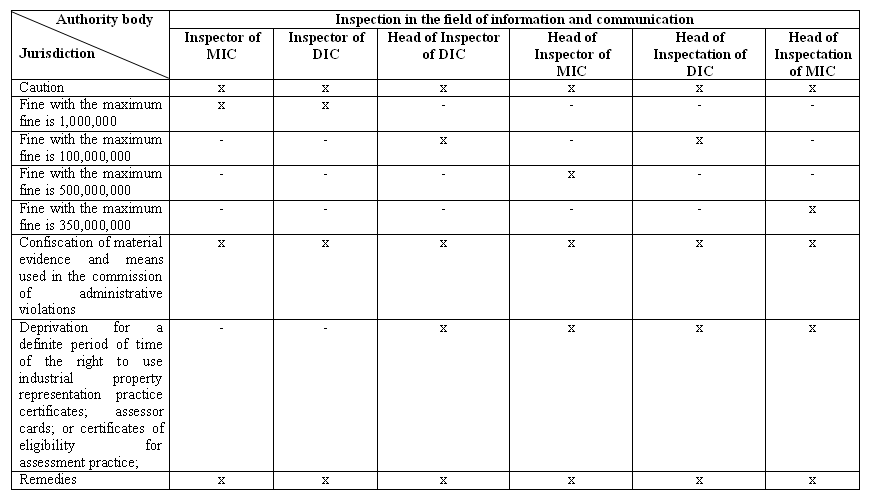
3. The inspector in the field of information and communication
The inspector in the field of information and communication includes the following person and authority state bodies:
– Inspector of Ministry of information and communication (MIC);
– Inspector of Department of information and communication (DIC);
– Head of inspector of MIC;
– Head of inspector of DIC;
– Head of inspectation of MIC (case by case);
Inspection in the field of information and communication only has the authority to settle the unfair competition relating to the use and registration of domain name that is confusingly similar/identical to a protected trademark.
The jurisdiction of the inspector in the field of information and communication are as following table:
Table 3
4. Market Surveillance
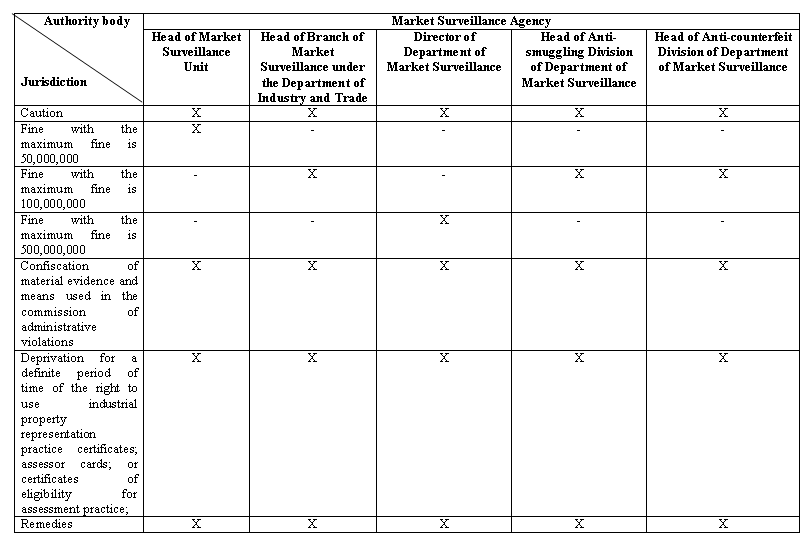
Counterfeit goods: The Market Surveillance could settle the actions of manufacturing, selling, transporting storing the counterfeit goods against the protected trademark and geographical indication on the domestic market.
Infringement action: In case of settling the product infringing upon the trademark, trade name, industrial design, Market Surveillance could settle the actions of selling and transporting of the infringement products at the domestic market. If the Market Surveillance could identify the manufacturer of the infringement products while settle the infringement, it could settle the infringement action at the location of manufacturing the infringement products.
The jurisdiction of Market Surveillance will be shown in the following table
Table 4
5. Vietnam Customs
The jurisdiction of Vietnam Customs could settle all of the infringement action in Table 1 when the goos has been transited or imported into Vietnam.
The detail of jurisdiction of Vietnam Customs are as the following table:
Table 5

6. Police
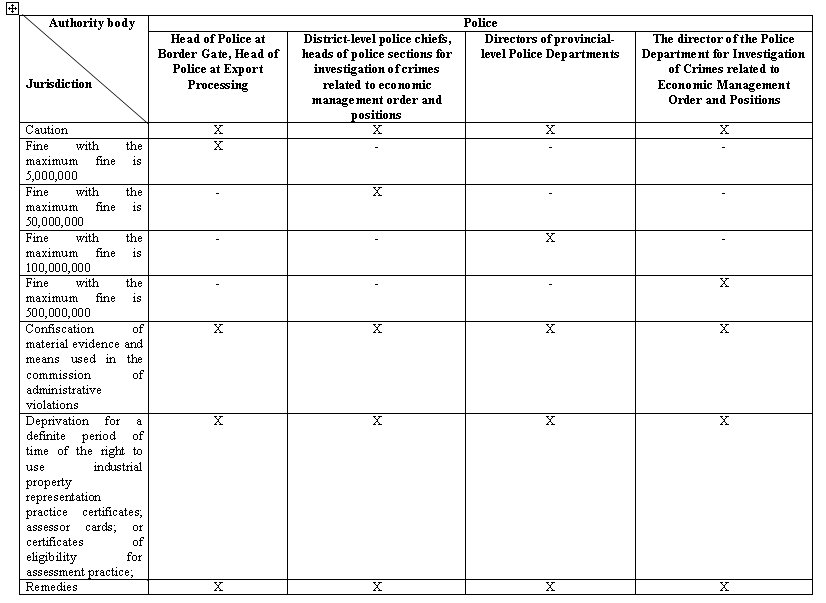
The Police only have the right to discover, investigate, and collect information and evidence and providing to the other authority state bodies. However, they have the right to settle and punish the action of manufacturing, importing, transporting, storing for the purpose of trading the counterfeit product of trademark, geographical indication and manufacturing, importing, transporting, storing for the purpose of trading the label, sign, material bearing the counterfeit of trademark and geographical indication.
The detail jurisdiction of Police will be shown in the following Table:
Table 6
7. People’s Committee
Provincial- and district-level People’s Committees are competent to handle violations in industrial property which are committed in their respective localities on the principle of determination of competence provided in Article 38 and 52 of Law on Handling of Administrative Violations.
Table 7
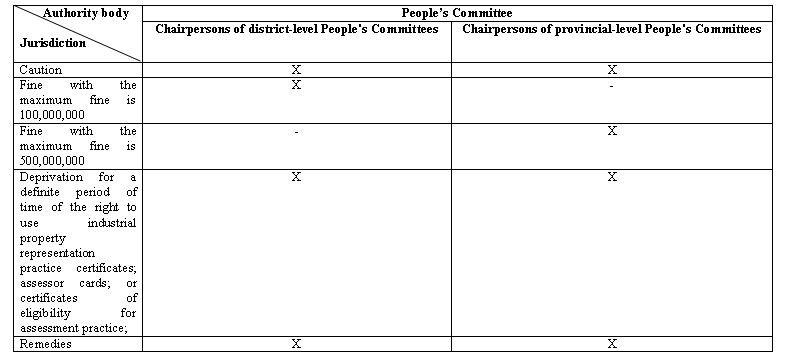
Note:
– The fine in the above mentioned tables are applied for organization. The fine for personal is ½ of the fine for organization;
– Remedies as aforementioned above include the following measures:
- Forcible removal of infringing elements on their goods or means of business; forcible removal of information or indications on infringing goods or services on their means of business, including also advertisement, media and computer networks, or alteration or revocation of domain names or enterprise names containing infringing elements;
- Forcible distribution or use for noncommercial purposes of goods bearing counterfeit marks or geographical indications or goods infringing upon industrial property rights; raw materials, materials and means used mainly for producing or trading in these goods, provided such act docs not affect the exercise of the industrial property rights by their holders:
- Forcible bringing out of the Vietnamese territory of transit goods infringing upon industrial property rights or forcible re-export of goods bearing counterfeit marks or geographical indications, or imported means, raw materials and materials used mainly for producing or trading in these goods after infringing elements on these goods arc removed;
- Forcible destruction of infringing elements, goods, evidence and means involved in violations on which infringing elements cannot be removed or infringing goods which may cause harms to the health of humans, domestic animals, plants and the environment; stamps, labels, packages and other articles bearing infringing elements;
- Forcible modification or addition of indications on industrial property;
- Forcible public correction of errors, for acts of giving wrong indications on industrial property rights:
- Forcible confiscation of dispersed material evidence or means of violation;
- Remittance into the state budget of illicit earnings from the commission of administrative violations.
Schedule of trademark fee in Vietnam

Question: One of our client needs to file a application in Vietnam. Please let us have your latest schedule of fee and help us to answer the following questions:
1.Please introduce the brief process for filling a application(including substantive examination) and how long it may take to grant a patent since the filing date.
2.Please let us know if you can translate Chinese into the official language acceptable by the IP Office and the cost for it.
Answen: We refer with thanks to your email concerning the above matter and we would like to advise as below:
1. The schedule of charge
i. Filing fees:
For your reference, the estimated costs for filing a patent application are calculated based on the number of independent claims, page of Vietnamese specification (estimated as the Chinese/English version of specification and drawings), priority claim and words of specification. Detail as follows:
|
Work |
Official fee (USD) |
Agency fee (USD) |
| 1. Filing a patent application (with one independent claim and not exceed 5 pages of specification) |
11.00 |
120.00 |
| – Addition fee for each independent claim from the second one |
10.70 |
45.00 |
| – Additional fee for each page of specification from the sixth
one |
0.70 |
1.00 |
| 2. Publication of patent application |
7.30 |
35.00 |
| 3. Request for substantive examination |
32.80 |
50.00 |
| – Additional charge for each independent claim from the
second one |
30.00 |
40.00 |
| 4. Translating fee from English/Chinese into Vietnamese (US$6.50 per 100 words) |
– |
Word basic |
| 5. Claiming priority (for each earlier application) |
36.40 |
50.00 |
ii. Estimated fee for granting:
|
Work |
Official fee (USD) |
Agency fee (USD) |
| 1. Granting patent for patent (including Register and Publication) for the first independent claim |
22.00 |
50.00 |
| – Additional charge for each independent claim from the
second one |
6.00 |
10.00 |
| 2. Annuities fee for the first year for the first independent claim |
20.00 |
50.00 |
| – Additional charge for each independent claim from the
second one |
20.00 |
0.00 |
Note: The above cost does not include 5% VAT (which is calculated based on our attorney’s fees) and communication costs (which will be billed on the basic of actual expenses). No other fees are payable in case the application goes smoothly, without any objection from a third party or the NOIP’s examiner. Fees for responding to any official action include fee for filing a response to official action shall be informed, if any.
2. Timeframe for examination of a patent application.
A patent application will be examined through the following process:
i) Formality examination: The Patent application undergoes one-month formality examination counted from the filing date.
ii) Publication: The Patent application is published within 2 months from the date such application is accepted as being valid.
iii) Substantive examination: The result of substantive examination is expected available within 18 months from the date of filing of the request for substantive examination (if it is filed after the publication date) or from the publication date (if it is filed before the publication date).
iv) Granting: Within 01 month from the date of Notification to Grant Patent for Invention/Utility model, the Applicant shall have to pay the registration and publication fees. The Patent shall then be granted and published in the Industrial Property Gazette within 02 months from date of Notification.
3. The required documents
In order to file a patent application in Vietnam, your client is required to provide with us the following document:
i) The Power of Attorney (as attached form) which is only simply to be signed by the Applicant, neither notarization nor legalization is required (The copy of the POA can be accepted at the time of filing but the original one must be lodged within 01 month from the filing date). Please find enclosed the form of POA for your simple prosecution
ii) A soft copy in word format of the Chinese specification of the application for translation into Vietnamese is requested to provide via email at the time of instruction.
We do hope that the above mentioned matter will be useful for you. Should you have any enquiry, please do not hesitate to contact us.
Thanks for your co-operation.
Fee quotation for filing a trademark application in Vietnam

Question: Dear Sirs, Please provide me a fee quotation for filing a trademark application in Vietnam. Thank you.
Answer: Thank you for your email today regarding the subject matter. Regarding your enquiries concerning the subject matter, we would like to advise you on the procedure and our fee schedule in relation to the trademark registration proceeding in Vietnam as follows:
1. FEE SCHEDULE
In Vietnam, multi-class application is applicable. The basic fees are calculated based on the number of class of goods/services (G/S) in each application as well as the number of products designated in each class in the application.
Below is the breakdown of charges for registering a trademark in Vietnam, in a smooth case, for your consideration:
– Trademark search (Optional)
|
Description |
Official Fees (USD) |
Attorney’s fee (USD) |
| 1. Fee for conducting a trademark search in one class (optional) |
80.00 |
Note: the above excludes 5% VAT.
– Trademark registration
|
Description |
Official Fees (USD) |
Attorney’s fee (USD) |
| 1. Fee for filing an application for one class of G/S with up to 6 items *
– for each additional goods from 7th one (if any) |
40.00
7.00 |
150.00
3.00 |
| 2. Fee for granting a registration certificate for one trademark in one class of G/S (without limitation of number of goods/services in each class)* |
20.00 |
60.00 |
|
Total (Sum of Items with *) |
270.00 In words: Two hundred and seventy US dollars. |
|
Note: The above-quoted fees do not include 5% VAT of our service charge, bank charges ($US30) and actual communication costs ($US30-$US 40).
In case of any office action or any possible opposition which may occur during the application proceedings, an additional charge may be incurred, upon the your approval.
2. PROCEDURE AND TIMELINE
The duration of a trademark application is around 14-18 months – from the filing date to the actual receipt of the registration.
The pricess involves these stages (1) formal examination and publication in the Gazette (3 months); (2) examination as to substance (9 months) and (3) issuance of registration certificate of the registered mark (2 months).
Kindly note that the term for registration process in practice normally takes up to several months longer due to the workload of the NOIP and the slow examination process by the NOIP’s examiner.
3. REQUIRED DOCUMENTS AND INFORMATION
– Name and address of the Applicant;
– List of Goods/Services;
– Specimen of the applied mark;
– An original Power of Attorney which is simply signed by the Applicant (our form in attachment) (Please be informed that a scanned/faxed copy of the Power of Attorney is acceptable upon filing provided that the original copy is submitted within 01 month from the filing date).
We hope the above is of your assistance. Should you have any inquiry, please do not hesitate to contact us. We look forward to hearing from you very soon.
Agencies have the power to deal with IPR infringement acts
Question: Which agencies in Vietnam have the power to deal with IPR infringement acts? What are the applicable procedures for dealing with IPR infringement acts?
Answer: Pursuant to Article 200 of the 2005 IP Law of Vietnam, the following agencies shall have the power to deal with IPR Infringement acts:
1. Courts
2. Inspectorates
3. Market control agencies
4. Customs authority
5. Police
6. People’s committees of various levels.
Depending on the acts, nature and seriousness of right infringement acts, such act of infringement shall be dealt with by one agency and the distribution of powers among the agencies is set out in detail in the IP Law and relevant documents.
Several specific details:
1. Courts:
Like a majority of countries in the world, Vietnamese courts have jurisdictions over civil cases involving disputes over IPRs in general under the civil procedure legislation or over IPR infringement offences under the criminal procedure legislation.
Vietnam does not yet have an IP court to deal with IPR disputes. These cases are usually assigned to the civil court or economic court under the provincial People’s court for first instance hearing
The civil court under the provincial/municipal People’s court shall hear for the first instance the non-profit disputes over IPRs (e.g. those disputes over personal rights of a work author)
The economic court under the provincial/municipal People’s court shall hear for the first instance the disputes over IPRs among organizations and individuals which are all for profit purpose (e.g. those disputes involving uses of trademarks on goods and products etc)
For a crime of IPR Infringement, it will be heard for the first instance by the district court.
2. Inspectorates:
Specialized inspectorates have the power to deal with IPR Infringements in their respective sector of control.
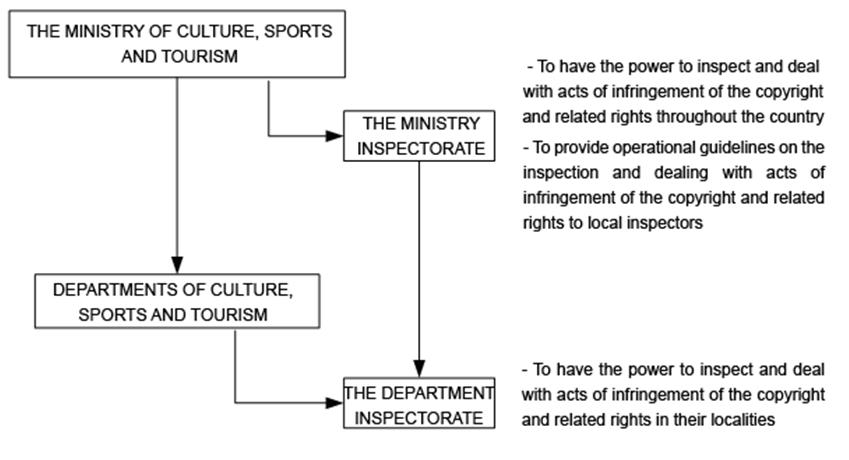
– Acts of infringement of related right and copyright: shall be deal with by the specialized inspectorate of the culture, sports and tourism sector under the Ministry of Culture, Sports and Tourism and its Departments of culture, sports and tourism of provinces and cities by way of administrative measures.
The Chief Inspector of the Ministry of Culture, Sports and Tourism has the power to impose a fine with the maximum value of VND500,000,000, Chief Inspectors of Departments of Culture, Sports and Tourism have the power to impose a maximum fine of VND30,000,000.
– IPR infringement acts relating to various industrial property subject matters (inventions, trademarks, industrial design etc): shall be deal with by the specialized inspectorate of the science and technology sector under the Ministry of Science and Technology (MoST), Department of Science and Technology (DoST) of provinces and cities by way of administrative measures (except for the industrial property infringement acts in import/export).
The Chief Inspector of MOST has the power to impose a fine with the maximum value of VND500,000,000, Chief Inspectors of DoST have the power to impose a maximum fine of VND30,000,000

Chart on the organization of the inspection forces of the science and technology sector:
– IPR infringement acts involving rights over plant varieties: shall be deal with by the specialized inspectorate of the agriculture and rural development sector under the Ministry of Agriculture and Rural Development (MARD) and Departments of Agriculture and Rural Development under provinces and cities (DARD) by way of administrative measures
The Chief Inspector of MARD has the power to impose a fine with the maximum value of VND30,000,000, Chief Inspectors of DARD have the power to impose a maximum fine of VND20,000,000
Chart on the organization of the inspection forces of the agriculture and rural development sector: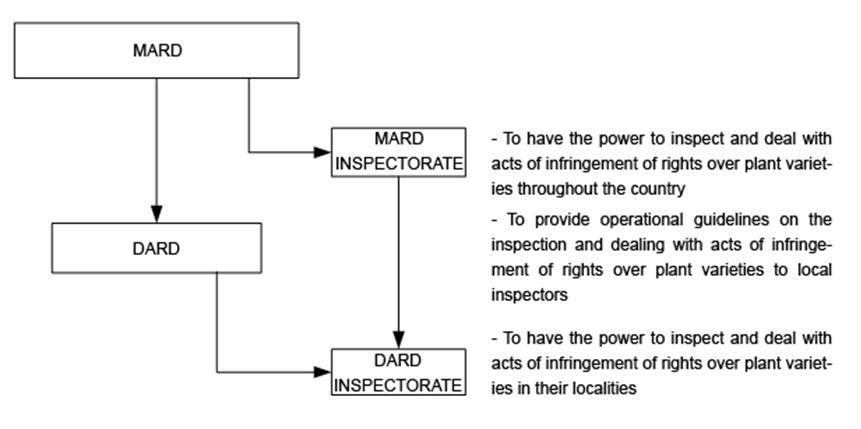
3. Market control agencies
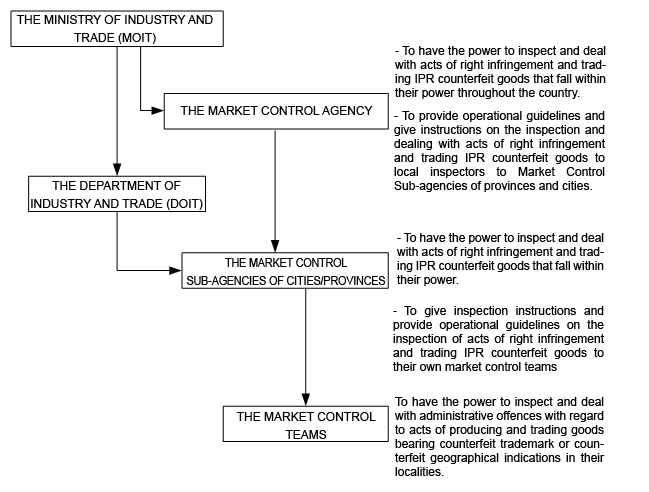
Market control agencies have the power to inspect and deal with acts of right infringement, and trading of IPR counterfeit goods during business and commercial activities.
The General Director of the Market Control Agency has the power to impose a maximum fine of VND70,000,000, Directors of Market Control Sub-agencies of provinces and cities have the power to impose a maximum fine of VND20,000,000, Heads of market control teams have the power to impose a maximum fine of VND5,000,000.
Chart on the organization of market control forces
4.Customs authority
The customs authority has the power to deal with IPR infringement acts during the export and import goods. Upon a suspect of any imported goods of infringing protected IPR, the IPR holder of intellectual property might request the customs authority to stay the completion of customs procedures with regard to the relevant shipment for inspection. If the shipment is detected to contain a sign of IPR infringement, the right holder may request the Customs authority to impose a penalty on the organization or individual importing those infringing goods.
5. Police
The police is responsible to investigate into and prosecute against IPR infringement crimes (assigned to the economic police). During the investigation and prosecution of an IPR infringement crime, however, if the police deems that there are not sufficient constituents of an IPR infringement crime but there are signs of an administrative offence, the police must transfer the file infringement cases to such agencies as inspectorates and market control agencies for their settlement.
6. People’s committees
People’s committees of various levels have the power to deal with IPR Infringement acts in their localities, however, in fact, the people’s committees only exercise this power when the fine level goes beyond the power of the heads of the department inspectorate, and market control sub-agencies, departments of customs of provinces and cities to decide and when the relevant case files are forwarded to them by those agencies together with a request for the chairman of the people’s committee to fine.
The chairmen of people’s committees of provinces and cities have the power to impose a maximum fine of VND500,000,000 (similar to the power of the Chief Inspector of MoST, and the Chief Inspector of the Ministry of Culture, Sports and Tourism).
With regard to the procedures for dealing with IPR Infringement acts, please go to the Page “Enforcement Measures” of this website.
What is meant by “circulated pharmaceutical substances.”?

Question: Regarding Article 2(3) “Regulation on Data Security of Drug Registration Records” (“Regulation on Data Security”), please explain what is meant by “circulated pharmaceutical substances.” Regarding the term “business secret” as it is used throughout the Regulation on Data Security, please explain the criteria by which it is determined that information received from financial investment or intellectual activities becomes qualified to be a “business secret”, and what laws, regulations, decrees, etc., provide for any such criteria.Regarding Article 4 (2), please explain what constitues “significant effort”.According to Article 4(1), data to be secured must qualify as a “business secret”. Please explain the resoning behind the requirement that date to be secured under Article 10(2) must qualify as a “business secret”.
Answer: The above regulations stipulated in the Regulation on data security of drug registration records (issued by the Decision No. 30/2006/QD-BYT of 30 September 2006”) should be interpreted as follows:
– “Circulated pharmaceutical subtances” can be interpreted that subtances of the final drugs are allowed to be circulated in Vietnam according to regulations on registration of drug circulation.
– A business secret, stipulated in Article 4.23 of the IP Law, means information obtained from activities of financial and/or intellectual investment, which has not yet been disclosed and can be used in business
– “Significant effort” is one of protection conditions for secret data, stipulated by the IP Law (Article 128.1) corresponding to the requirements in Article 39.3 of the TRIPS Agreement. This term has not been specifically interpreted in the IP Law and the existing guidelines.
– The requirement that date to be protected must qualify as a “business secret” is provided for in Article 128.1 of the IP Law. The Law stipulating mechanism for protection of secret data under the protection of “business secret” comes from the requirement for protection of undisclosed data under the protection of “undisclosed information” in the Article 39 of the TRIPS Agreement. Secret data is a kind of undisclosed information (business secret), and only different in a way that such data should be submitted to a competent State agency in compliance with procedures for registration of product circulation. Therefore, undisclosed data is protected according to general principles on protection of “business secret” and particular regulations on responsibility of a state agency for data security in order that after being submitted, the data is still protected as if it was under the right holder’s control.
Licenses for trading in or circulating pharmaceuticals or agrochemical products
Question: According to Article 128.1 of the Intellectual Property Law, applicants for licenses for trading in or circulating pharmaceuticals or agrochemical products need to specifically request such data to be kept secret. Please also access the compliance of Article 128 with the Article 39 of the TRIPS Agreement.
Answer: In compliance with Article 39 of the TRIPS Agreement, the IP Law provides protection of secret data if such data meet certain conditions (as mentioned in the question above), but not protection of all data in the request for circulation of the product. In order to keep the data secret, the competent licensing agency must know which data in the registration record is subject to protection. Therefore, the applicant should make a claim, identify data to be protected, and prove that such data meet protection conditions.
Stay the completion of customs procedures
|
Stay the completion of customs procedures
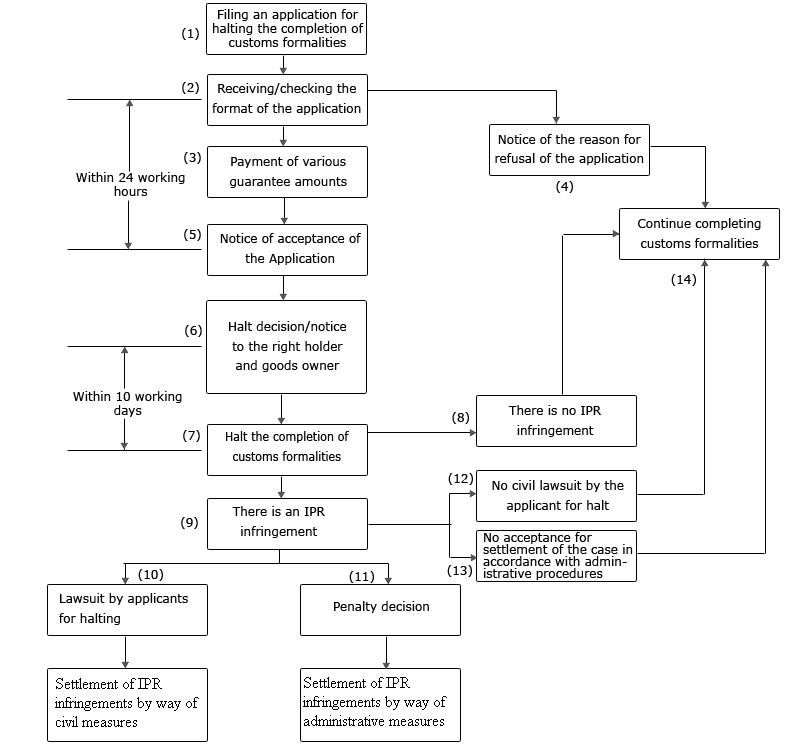
This measure of stay of the completion of customs procedures shall be taken at the request of the holder of an IPR protected in Vietnam, in order to collect information and evidence about a goods shipment to enable the IPR Holder to exercise his/her right to request for the settlement of an act of infringement and to request for application of provisional measures or preventative measures and to ensure that such act of infringement is properly dealt with through the administrative channel. |
CHART OF THE PROCEDURES FOR APPLICATION OF THE MEASURE TO HALT THE COMPLETION OF CUSTOMS FORMALITIES
| (1) | Right holder files either directly or through an industrial property agent an application for halting the completion of customs formalities (Article 34 Decree 105/2005/NĐ-CP). |
| (2) | Checking: (i) evidence proving the right holder status of the applicant, (ii) information about the suspected goods or in order to detect IPR infringing goods (Article 23, Article 24, Article 25 of Decree 105/2005/NĐ-CP, clause 3 Article 48 Decree 154/2005/NĐ-CP) |
| (3) | The applicant must deposit an amount of money equal to 20% of the value of the shipment or 20 million dong (in case the value of the shipment cannot be identified) or a document of guarantee from a bank/credit institution (Article 217 of the IP Law). |
| (4) | The customs authority issues a notice of refusal of the application for halting the completion of customs formalities if the applicant fails to meet the requirements set out in points (2) and (3) (Article 36 of Decree 105/2006/NĐ-CP). |
| (5) | The Customs authority issues a notice of acceptance of the application for halting the completion of customs formalities if the applicant meets the requirements set out in points (2) and (3)(Article 36 of Decree 105/2006/NĐ-CP). |
| (6) | Upon discovering the suspected goods, the customs authority shall issue a decision to halt the completion of customs formalities (either at the request of the IPR holder or to exercise the power to impose administrative penalties) (Article 36, Article 37 of Decree 105/2005/NĐ-CP, Article 51 of Decree 154/2005/NĐ-CP). |
| (7) | To take the halting measure and leave time for related parties to produce evidence, arguments, documents and examine and verify the IPR-related legal status in order to determine whether or not an act of IPR infringement has been committed or not (Article 51 of Decree 154/2005/NĐ-CP). |
| (8) | In case there is no infringement of the IPR: (i) Results relating to the IPR status of the shipment conforming that the halted shipment does not infringe upon IPR, (ii) a decision of the IPR dispute resolution authority confirming that the shipment does not infringe upon IPRs. The customs authority shall continue completing customs formalities for the shipment.. |
| (9) | If the customs authority concludes that the halted goods infringe upon the IPR, the goods owners and the goods shall be liable for the penalties set out in points (10) Or (11) Depending on the choice of the IPR Holder. |
| (12) | If the customs authority concludes that the halted goods infringe upon IPRs under point 9 and the right holder does not initiate a civil lawsuit |
| (13) | The customs authority decides not to consider the application of the administrative penalties (Article 214,, 215 of the IP Law) The halted shipment shall be further released for completion of the customs formalities (Article 219 of the IP Law). |
| (14) | The customs authority shall continue the completion of the customs formalities when: (i) The application for halting is rejected; or (ii) The applicant withdraws the application for halting the completion of customs formalities, or (iii) Upon the expiry date of the halting period, the Customs authority does not receive an application for settlement of the IPR Infringement from the applicant or a document from a State competent agency or from the court confirming that they have received an application for settlement of the IPR infringement relating to the halted shipment; or (iv) The results of determination of the IPR-related legal status confirming that the halted shipment does not infringe upon IPRs; or (v) The applicant for halting does not initiate the civil lawsuit; or (vi) The Customs authority does not accept the case for settlement in accordance with the procedures for dealing with administrative offences; or (vii) A decision on halting the completion of customs formalities is suspended or revoked under a complaint settlement decision. (Clause 3, Article 218 of the IP Law, Article 52 of Decree 154/2005/NĐ-CP, clause 1, Article 36, Article 37 of Decree 105/2006/NĐ-CP, Article 219 of IP Law). |
Source: http://iprenforcement.most.gov.vn/